
Carson City Projected Versus Actual Release
A projected date is an administrative calculation based on the judgment, sentence structure, credits, and current facts. An actual date records an event that occurred. Nevada felony judgments often contain minimum and maximum terms. Eligibility at the minimum permits Board consideration where law allows; it does not promise release.
A person held before trial generally has no sentence-based date. Bail, dismissal, a court order, plea, or transfer may change custody. A Carson City jail sentence follows the judgment and local-jail rules. An NDOC term has state prison fields and credit rules. One calculation cannot be copied onto the other.
“Release” may also mean transfer to parole, another jurisdiction, or another custodian. NDOC descriptions include release for discharge, court-ordered release, medical release, transfer to parole, other jurisdiction, and release to committing authority. Read the code with the status before describing community release.
Find a Carson City Projected Date
The sheriff's current roster covers people now in the Carson City jail, not a historical date archive. The official NDOC offender search covers Nevada prison commitments. Court files supply the judgment, sentence, bail orders, and jail credit. Each source answers a different part.
- Identify the custodian: Carson City jail, NDOC, federal prison, or another agency.
- Obtain the judgment and offense date, then note minimum and maximum terms.
- Record concurrent or consecutive terms and court-awarded confinement credit.
- For NDOC, search by offender ID and confirm at least two identity details.
- Copy the label exactly, including Sent. PED, Sent. MPR, Sent. PEXD, parole, or discharge.
- Check Board action only when parole is relevant.
- After the date, confirm the actual disposition with the custodian.
An institution listed as “PAROLE” with status “Paroled” indicates community supervision, not discharge. A different prison can mean transfer. If the public detail is unclear, request time-computation and release records from Offender Management at omdrecords@doc.nv.gov, P.O. Box 7011, Carson City, NV 89702.
Nevada Credits Shape Carson City Dates
There is no general Nevada 85 percent service rule. Nevada uses minimum and maximum terms, parole eligibility, and offense-date-specific credit law. NRS 193.130's general limit on an imposed minimum is a sentencing-range rule, not a promise of release at 40 percent.
For qualifying crimes committed on or after July 17, 1997, NRS 209.4465 provides conduct credit and possible labor, study, program, education, discretionary, or meritorious credit. It has exclusions and limits. Credits generally reduce the maximum. They reduce the minimum only where subsection 8 permits. For some post-July 2014 cases, subsection 9 caps qualifying minimum-term reduction at 58 percent.
Earlier crimes can fall under NRS 209.446 or predecessor law. A scheduled 2027 change is not current law. For a county sentence, NRS 211.110 supplies a separate deduction framework, subject to its terms and local administration. Presentence credit and the Carson City judgment can also matter.
Parole eligibility under NRS Chapter 213 means the Board may consider release. It is not a grant. The Board action and NDOC actual release entry must confirm that a prison movement occurred.
Why Carson City Release Dates Move
A projected date can change as the underlying facts change. A dated screenshot may have been accurate when captured yet no longer match a later computation. Confirm the reason through the record that controls it.
| Factor | Effect | Confirmation |
|---|---|---|
| Multiple terms | Concurrent or consecutive structure changes the total | Judgment and computation |
| Credits | Qualifying credit can reduce a term | Statute and NDOC record |
| Forfeiture or restoration | Moves a prison calculation | NDOC time record |
| Board action | May grant, deny, defer, or rescind parole | Board action and status |
| Detainer | May send the person to another custodian | Both agencies |
| Court order | Can amend custody authority | Filed court record |
A parole grant may still depend on a plan, effective date, hold review, or later action. The decision date is not always the door-out time. NDOC status and the actual movement record remain the best confirmation.
Confirm Carson City Release Dates
Compare the NDOC profile with the release dataset or request admission, movement, parole-release, expiration, discharge, and time-computation records. Include the NDOC number, full name, birth date, date range, and desired format. Do not ask staff to infer an actual event from a projected field.
The NDOC records page supplies the formal fallback when public date fields lack context.
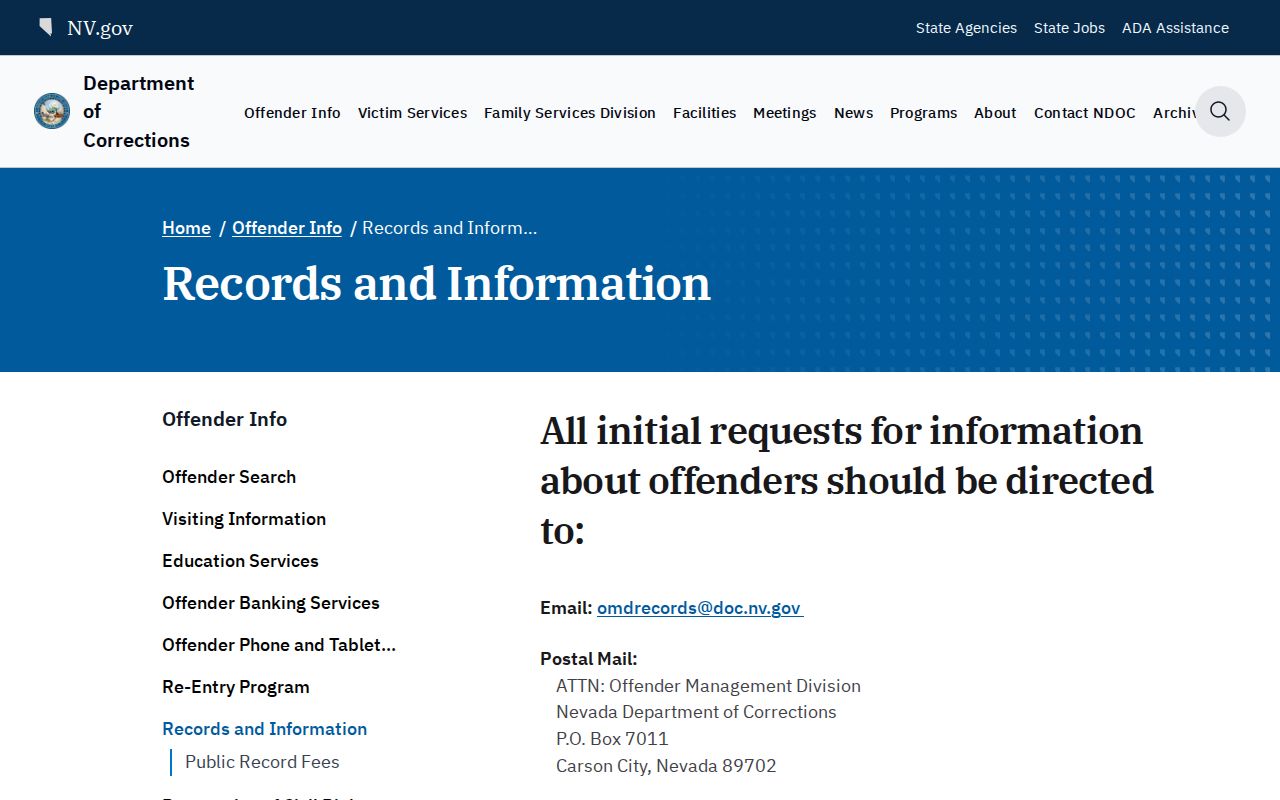
The records channel can document the computation and final disposition rather than leaving the meaning of a short search label unresolved.
Nevada S.A.V.E. may send an event notice for a participating agency. Nevada ended VINE in 2025, so the current VINE Inmate Check points to SAVE. A notice is still a prompt to verify because periodic data may lag.
Carson City Release Timing Limits
No official Carson City source found states a special weekend or holiday early-release formula. There is no basis to claim every Sunday release occurs Friday. The sheriff instead says the detention operation handles more than 4,000 intakes and releases annually and cannot forecast an exact release time.
A court order provides legal authority, but staff still resolve holds, process property, and record the disposition. For a jail case, ask the records unit about status without treating an estimate as fixed. For NDOC, distinguish a projected field from Board action and final movement.
Keep the time of each check, the agency contacted, and its exact wording. That small log helps reconcile a court date, roster absence, SAVE event, and final release entry when updates arrive at different times.
Carson City Date Record Requests
NRS Chapter 239 supports access to nonconfidential public records. NRS 239.0107 requires a response by the end of the fifth business day that provides access, states lack of custody, cites confidentiality, or gives the expected date. It is not a five-day production guarantee.
Ask narrowly for actual and projected fields, sentence structure, credits, parole-release, and discharge for a stated period. For the sheriff, request booking and release date and time, disposition, court number, and any public transfer destination. Sealed, juvenile, investigative, personal, or security data may be redacted.
Online display length is not a retention schedule. The Carson City released-inmate records path shows how jail, court, and NDOC records work together.
Read Carson City Date Labels
Nevada prison records can present several date labels on one sentence. Sent. PED refers to a parole eligibility date. Sent. MPR and Sent. PEXD describe other computed milestones. Minimum and maximum fields describe the court's sentence structure. None should be renamed “release date” without checking the agency's definition and the whole offender detail.
The offense date is as important as the displayed date. It determines which credit statute may apply. The county of conviction, sentence type, start date, and concurrent or consecutive structure can also explain why two terms do not end when a quick calculation suggests. When an abbreviation remains unclear, quote it in the records request and ask NDOC to identify the field.
A former prisoner can remain searchable. NDOC examples include inactive discharge wording, while parole examples can list the institution as PAROLE and the sentence status as Paroled. The first points toward a completed release or discharge event. The second shows that prison custody changed to supervised community status. Neither should be inferred from disappearance alone.
For a Carson City jail sentence, rely on the filed judgment and jail record instead of expecting NDOC labels. A short local term may never produce an NDOC profile. The court can establish the sentence and credit awarded, while the sheriff's record establishes the actual release time and disposition.
Carson City Parole Date Checks
A parole hearing date, parole eligibility date, and parole release date mark different stages. The Nevada Board publishes monthly hearing schedules and monthly action documents. A schedule shows that a matter was set for consideration. An action may show a grant, denial, continuance, deferral, or rescission issue. Neither document alone proves that NDOC released the person.
Board materials warn that eligibility dates may change. Names can also leave a schedule when a person moves or is found ineligible, and some end-of-month actions can appear later. If a grant is shown, check the effective date, any approved release plan, and possible detainers. Then return to NDOC's status and release data after the expected event.
A denial can change the next possible review without altering the maximum discharge computation in the same way. Consecutive terms and offense-specific exclusions may also affect eligibility. NRS Chapter 213 supplies the parole framework, while NRS Chapter 209 credit provisions apply only as their text permits.
For a practical Carson City check, obtain the NDOC number first. Match it in the offender profile, calendar, and action record. Record each document's date. If the person is then physically released on parole, the Division of Parole and Probation may identify the supervising office where disclosure rules allow. This sequence separates the Board's decision from NDOC movement and later community supervision.